
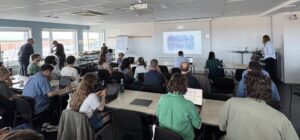
Project updates, valuable feedback and input from stakeholders
The meeting opened with a project overview by the coordinator, Torben Koenigk, who presented the current status of the project and highlighted key achievements to date. This was followed by updates from all work packages. 3.5 years into the project, several tasks, deliverables and milestones have been successfully completed, resulting in a growing number of scientific publications, demonstrating the strong progress made across the project. OptimESM also received feedback from the External Advisory Board pointing out OptimESM’s excellent and essential collaboration with other projects.
For the joint sessions, DMI Director General Marianne Thyrring welcomed the consortium to Copenhagen and reiterated the contribution of climate science to decision-making.
The important connection between climate change, tipping points and human rights was also highlighted in the presentation by Elisa Morgera, UN Special Rapporteur on Climate Change from United Nations Human Rights. She pointed out the importance of climate change and tipping point research in driving integrated action on climate change, biodiversity and human rights and health as well as international laws on nature, ocean and land
In addition, an overview of IPCC timelines and expectations was given by Thomas Frölicher and Roland Séférian, and OptimESM research will provide essential contributions to the AR7.
OptimESM also contributed to the engaging Outreach event that was held with policy makers, civil society and NGOs.
Enriching science sessions with focus on Earth System Models and Tipping Points
Across dedicated breakout sessions, the topics discussed included Development of High Resolution ESMs, New and Improved ESM Parameterizations, Representation of Earth System Processes Linked to Abrupt Changes, Machine Learning Downscaling Plans and Regional Analysis, Strong Nonlinear Surprises and Consequences of an AMOC Collapse and Evaluation of AMOC Tipping point Characterization Methods.
Time was also allocated for informal discussions, allowing participants to take advantage of the unique opportunity to engage with many OptimESM and TipESM colleagues gathered in the same place.
A workshop on AI downscaling was held for those interested in this highly relevant and evolving topic.
Several talks focused on key climate challenges, including changes in the Jet Stream and European summer precipitation, ice-shelf tipping points driven by freshwater fluxes, and the persistence of Arctic Ocean acidification.
The final group discussions focused on the analysis of new simulations (ScenarioMIP and domain simulations), the carbon cycle and vegetation, and the drivers and impacts of tipping points.
OptimESM project manager Nikki Brown remarked: “There are close synergies between the OptimESM and TipESM projects. We really saw the value of joining forces for our respective annual meetings underlined by the many animated discussions and plans for common actions generated during our days together.”
Spotlight on Early Career Researchers
There was a focus on Early Career Researchers (ECRs) giving them the opportunity to introduce themselves. They also had the possibility to have a one-to-one lunch discussion with experienced scientists for a mentoring conversation exploring career pathways, how to establish fruitful collaborations and how to make your science matter.
Next steps for collaboration and research
There was also participation from EU-projects and activities such as EERIE (European Eddy-Rich Earth System Models), Destination Earth (DestinE), AERA, FUTURA, MESACLIP and ClimTip. Many potential opportunities for collaboration were identified, and the process of determining the best ways to collaborate will continue after the meeting. There is also a plan for multi-model analysis of the TIPMIP ESM Tier 1 simulations across OptimESM and TipESM.
Joining forces and hosting the OptimESM General Assembly and the TipESM Annual Meeting together was a great success! Many thanks to everyone who came along or joined online and contributed with presentations and lively discussion. OptimESM looks forward to building on this opportunity and further developing our collaboration with TipESM and other partners.
 English